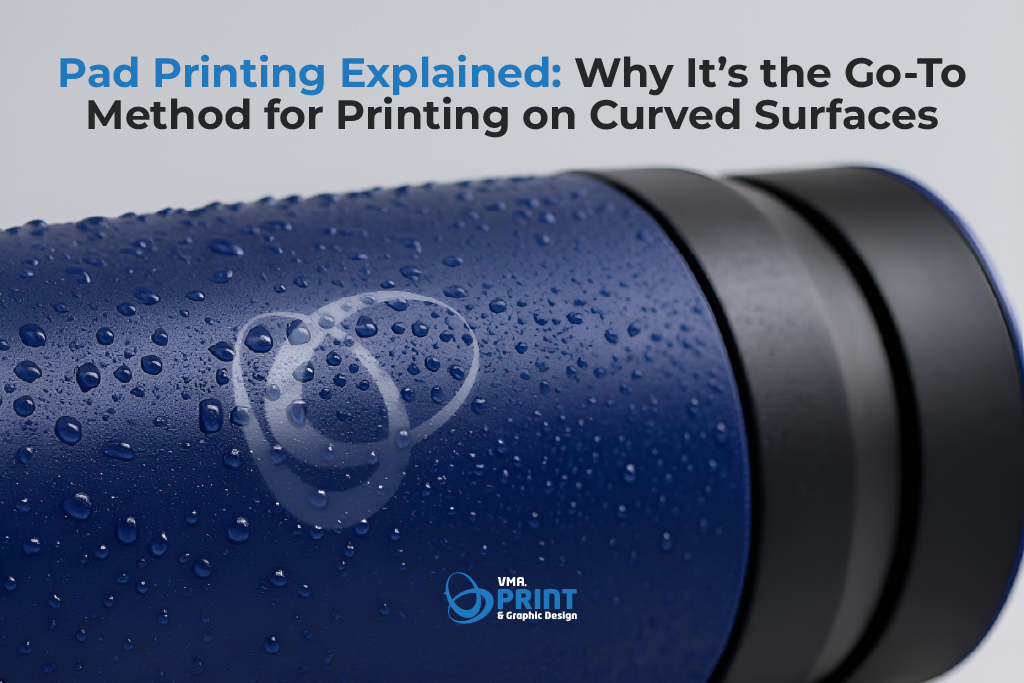
Printing on a flat sheet of paper is straightforward. Even printing on a flat piece of plastic or metal doesn’t present much of a challenge for modern machinery. However, the difficulty level rises significantly when you need to place a high-definition logo on the dimpled surface of a golf ball, the sloping side of a coffee mug, or the intricate, tiny buttons of a car dashboard.
This is where pad printing (technically known as tampography) becomes the hero of the manufacturing world. Often described as the “offset printing of the 3D world,” it is the most reliable and versatile solution for transferring 2D images onto complex, 3D substrates. For businesses looking for precision branding on irregular shapes, understanding this process is the first step toward achieving a professional finish.
What Exactly is Pad Printing?
At its heart, pad printing is a “soft” transfer process. Think of it like a high-tech rubber stamp, but with a lot more science involved. The process uses a flexible silicone pad to pick up an image from a flat cliché (a printing plate) and press it onto the product.
The Mechanics of the Move
The magic lies in how the ink moves from the plate to the pad, and finally to the product. It involves three main components:
-
The Cliché (Printing Plate): Your artwork is etched or engraved into this plate. In modern high-volume setups, these are often made of hardened steel or laser-etched polymers to ensure the image remains crisp over thousands of impressions.
-
The Ink Well or Closed Cup System: Most modern machines use a sealed ink cup. This cup acts like a reservoir, sliding back and forth over the cliché. It applies ink to the etched image and then uses a doctor blade (the ceramic ring on the cup) to scrape away the excess, leaving ink only in the etched area.
-
The Silicone Pad: This is the “transfer vehicle.” Because silicone is flexible and has a low surface tension, it can “squish” into the etched plate to pick up the ink and then conform perfectly to the shape of the object it’s printing on.
Did you know?
The original pad printing “pads” weren’t made of silicone at all. In the 19th century, Swiss watchmakers used bags made of soft gelatin to transfer intricate numbers onto watch faces. It wasn’t until the mid-1960s that cold-vulcanised silicone was developed, which revolutionised the industry by making the process more durable and consistent.
Why It’s the “Go-To” Method for Curves
You might wonder why we don’t just use screen printing or digital UV printing for everything. The answer comes down to geometry.
1. Conforming to Irregular Shapes
Traditional screen printing requires a flat or perfectly cylindrical surface to work. If you try to screen print on a sphere or a concave surface, the screen can’t make proper contact. A silicone pad, however, can wrap around a curve, dip into a hollow, or press over a textured surface without distorting the image. This makes it the only viable choice for items like:
- Convex surfaces (balls, helmets, curved electronics).
- Concave surfaces (the inside of bowls or certain medical trays).
- Textured materials (grained plastics or matte-finished metals).
2. Precision and Fine Detail
Because the ink film in pad printing is very thin, it allows for incredibly high precision registration. This is why you see pad printing on the tiny icons of a computer keyboard or the microscopic graduation lines on a medical syringe. The ink adhesion is also superior because the ink is formulated specifically for the substrate—whether it’s medical-grade plastic or industrial-strength metal.
3. Durability and Material Versatility
One of the biggest advantages for Australian businesses is the sheer range of materials pad printing can handle. Whether you are branding promotional pens or marking heavy-duty automotive parts, the process remains the same, though the ink chemistry changes.
- Plastics: From ABS to Polypropylene, pad printing offers excellent bonding.
- Metals: Stainless steel, aluminium, and coated metals are easily branded.
- Glass and Ceramics: Often used for glassware where the print needs to survive a dishwasher.
To ensure the print doesn’t scratch off, manufacturers often use UV curing or heat tunnels to “set” the ink. For more difficult materials, primers or a process called “flame treatment” might be used to increase the surface energy of the product, ensuring the ink sticks for the long haul.
Did you know?
Pad printing is so precise and safe that it is even used in the pharmaceutical industry. Specially formulated edible inks are used to print logos and dosage information directly onto pills and capsules. The process is gentle enough that it doesn’t crack the delicate coating of the medication.
Pad Printing vs. Other Methods
To understand why pad printing is chosen so often, it helps to see how it stacks up against the competition.
|
Feature |
Pad Printing |
Screen Printing |
Digital UV |
|
Surface Shape |
Irregular, Curved, 3D |
Flat or Cylindrical |
Mostly Flat |
|
Detail Level |
Extremely High |
Moderate |
High |
|
Substrate Variety |
Almost anything |
Mostly flat plastics/fabrics |
Specific coated surfaces |
|
Speed |
Fast (Up to 1,000+ per hour) |
Fast (for flat items) |
Slower (print head travel) |
|
Setup Cost |
Low to Moderate |
Moderate |
Low (no plates) |
While digital printing is great for short runs with many colours, pad printing wins on speed and the ability to hit Pantone Color Matching (PMS) with 100% accuracy on dark or oddly shaped backgrounds.
Modern Trends: Sustainability and Technology
As we move through 2026, the industry is shifting toward “greener” practices. The days of heavy solvent-based inks are fading. Today, there is a massive push toward low-VOC (Volatile Organic Compound) inks and water-based alternatives that are better for the environment and the workers operating the machines.
Furthermore, automation is changing the game. Many pad printing setups now include Vision Inspection Systems. These use high-speed cameras to check every single print as it leaves the machine. If a logo is even 0.1mm out of alignment, the system flags it. This level of precision registration is why pad printing remains the standard for the medical and aerospace sectors.
Common Industrial Applications
If you look around your room right now, you are likely within arm’s reach of at least five pad-printed items.
-
Automotive: The icons on your indicators, the labels on your gear stick, and the branding on your engine covers. These require high abrasion resistance to last the life of the car.
-
Medical Devices: Catheters, syringes, and inhalers. These must use USP Class VI certified inks to ensure they are safe for human contact.
-
Electronics: The “On/Off” button on your microwave, the branding on your smartphone charger, and the symbols on your remote control.
-
Promotional Products: This is the most visible use—branded pens, fidget spinners, and drink bottles.
Did you know?
The longest-running pad printing machine might be found in the toy industry. For decades, iconic brands like LEGO have used pad printing to give their “Minifigures” their faces and outfits. Because the plastic (ABS) is notoriously difficult to print on, pad printing is the only way to ensure the faces don’t rub off after years of play.
Conclusion: Making a Lasting Impression
Pad printing isn’t just about putting a logo on a product; it’s about solving the problem of “how do we mark this?” when the object refuses to be flat. Its unique combination of flexibility, durability, and cost-effectiveness makes it an essential tool for any business that values high-quality branding.
From the tiny markings on a surgical tool to the bright logo on a corporate gift, pad printing provides a level of detail and versatility that other methods simply cannot match. If your product has a curve, a texture, or a complex 3D shape, pad printing is almost certainly the solution you need.